


Tags
Creators
Details
All versions
1.3
Acatar 1.3-The Sakura Spirit Updatelast year 58
Compatibility
Minecraft: Java Edition
Platforms
Supported environments
Changes
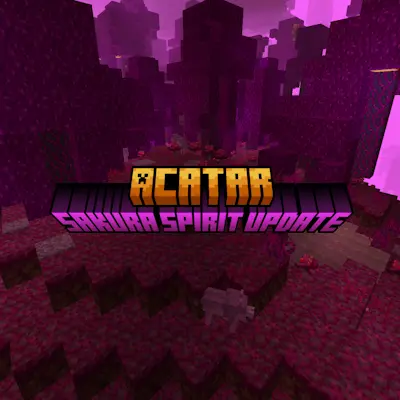
🪄ADD
- All armor sets (except the Space Armor) can now have Smithing Templates (only available with vanilla materials like diamond, emerald, iron, gold, redstone, etc.)
- Added 2 crafting recipes for the Bad Omen potion: one in the crafting table (9 ingredients) and one in the brewing stand 🧪
- Added the Dioptasium Apple 🍏
- Added Sulfur, crafted with blaze powder 🔥
- New ore: Lead ⛏️
- New ingot: Hazmium, crafted with sulfur, lead, glowstone dust, and gold — used for the Hazmat armor ⚗️
- The Hazmat Armor is now available in survival 🧍♂️
- New enchantment: Radiation Protection ☢️
- Added 2 new advancements 🏆
- Added Sakura Roots 🌸
- Added Sakura Moss Carpet 🌿
- The Sakura Mushroom now spawns naturally in the Sakura Forest 🍄
- New flower: Antheria 🌺
- New creature: Lyvora Wolf 🐺
- New food: Lyvorian Berry 🍇
🧩FIXES AND MODIFICATIONS
- 💡 Slightly reduced the brightness of the Uranium Ingot
- ☠️ Uranium Ore now applies Poison if you’re not wearing the Hazmat Armor or an armor with “Radiation Protection” (⚠️ this feature is still unstable — prefer Hazmat Armor for now)
- 🔢 Changed advancement numbers: 5 & 6 → 7 & 8
- 🧱 Updated icon for the “What Is This?” advancement (Carmeltazite)
- 💣 [⚠️] The Nuclear Bomb is still in testing phase
- 🌾 The Explosive Mushroom can now be placed on dirt
- 🐗 Reduced Piglin, Hoglin, and Zombified Piglin spawn rates in the Sakura biome
- 🌸 [⚠️] The Sakura Mushroom can now only grow with a Red Crystal or Bone Meal
- 🈁 Fixed translation: “Sakura Wart Block” → “Bloc de verrue Sakura”
- 🌱 Sakura Nylium now spreads like Crimson Nylium when using Bone Meal
- 🔥 The Sakura Biome can now naturally generate Ruined Portals
- 👁️ Increased detection range of the Eye of Revelation