
Compatibility
Minecraft: Java Edition
Platforms


Tags
Creators
Details
Licensed MIT
Published 3 weeks ago
Updated 2 weeks ago
Clickable, pixel-positioned GUIs inside vanilla Minecraft dialogs — no client mod.
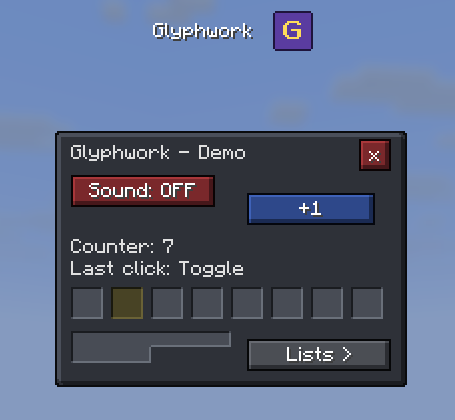
Glyphwork renders whole screens (panels, buttons, lists, grids, text) into the dialog screen that Minecraft has had since 1.21.6. Players only need a resource pack, which Glyphwork generates and sends by itself. Everything is clickable exactly where it is drawn.
For whom
- Server admins: describe menus in YAML files (buttons that run commands, open other menus or ask for input, sliders, checkboxes, choices and forms, PlaceholderAPI, a command per menu, conditions, templates, variables, tabs, scroll panes, cooldowns, click sounds, progress bars that change color by value, lists of online players, worlds, RSS feeds or JSON web APIs, menus that refresh themselves) - no coding. See the menu guide, or build them with the mouse in the menu designer.
- Plugin developers: build screens with the Java API.
# plugins/Glyphwork/menus/warps.yml  ->  /warps
title: "<gold>Warps"
command: warps
elements:
  - type: button
    x: 8
    y: 24
    width: 72
    height: 16
    text: "Spawn"
    tint: "#50E050"
    actions: ["player: spawn", "close"]
Features
- Scene API for plugin developers: panels of any tile shape, labels, buttons, invisible hitboxes, lists and grids with automatic paging, tooltips, colors, per-player state, navigation (open / back / reopen / close), tabs, scroll panes, progress bars, own pictures, big player heads, text with bold / italics / underline, sliders, checkboxes and choice buttons drawn from the skin, and text input or whole forms (text, slider, checkbox, choice) through small native dialogs. Screens shared by several players (games, lobbies, auctions): redraw another player's open screen, ask which scene is open, know why a screen closed. Stable from 1.0 on: no breaking changes within 1.x.
- Item icons for 1595 items in grids, buttons, lists and menus, drawn from the textures every client already has. Icons follow your server's resource pack: replaced textures are measured, and the pack's own items (
myserver:ruby) work as icons. Player heads as small 8 x 8 icons (head:Steve), e.g. in a list of online players, or painted from the skin at 16 to 32 px on buttons, lists and grids. Stack counts at the icon like in the inventory. GUI sprites too: hearts, food, armor, every status effect, statistics and small icons (gui:hud/heart/full,gui:mob_effect/speed). - Own pictures (PNG, any size) placed like any element, also smaller or bigger (
width,height,scale). - Own fonts (since 1.4, experimental): put a TrueType/OpenType font (a file or a URL) into
config.ymland use it withfont:on the menu or any text element. Glyphwork draws it into the pack itself, so wrapping, cutting and centering stay pixel-exact; pixel fonts look best. Letters a font lacks come from the Minecraft font. - Pixel-exact clicks, also off the 9 px text grid.
- Skins: frames are autotiled from tiny sheets, so any shape joins seamlessly. Three skins are built in (vanilla, dark, parchment); make your own with the browser-based skin editor.
- Menu designer in the browser: place elements with the mouse, edit forms and variables, try the menu out and download the YAML file, for the Glyphwork version your server runs. With your own client jar loaded it shows the real item icons and font (read only in your browser), and with the font files Glyphwork writes it previews your own fonts too.
- Example plugin to copy from: a small trader built against the API, attached to every release.
- Resource pack handled for you: generated on start, stable hash (no re-downloads), served by a built-in web server, written to disk for your own web server / CDN, or merged into the pack your server or proxy sends. Or the other way round: your server's pack goes into the Glyphwork pack, so players get a single pack.
- Plain dialog: players who decline the pack, and Bedrock players through Geyser, get a native dialog built from the same screen (or an own plain view of the menu).
- Display mode per player (full / without icons / plain) for players whose own resource pack tears the menus:
/glyphwork display, or controlled by your own system through the API. - English and German messages and commands, picked per player from the game language; edit the texts or add languages in
plugins/Glyphwork/lang/. /glyphwork reloadapplies config and skin changes and sends the new pack to everyone online.
Setup
- Put the jar into
plugins/of a Paper 26.1 to 26.3 server (26.1.2, 26.2, 26.3; Java 25) and start it. For Paper 1.21.11 take the-mc1.21.11version (Java 21). - In
plugins/Glyphwork/config.ymlsetpack.urlto an address your players can reach (built-in server: openpack-server.port; orpack.hosting: externalwith your own web server). /glyphwork reload, then/glyphwork test(demo) or/glyphwork menu example(example menu;beispielon German servers).
For developers
Scene settings = Scene.builder("myplugin:settings", 176, 96)
    .background()
    .add(Label.of(8, 7, "Settings"))
    .add(Button.of(8, 24, 80, 16)
        .text(v -> soundOn(v.player()) ? "Sound: ON" : "Sound: OFF")
        .onClick(c -> { toggleSound(c.player()); c.reopen(); }))
    .build();
Glyphwork.get().open(player, settings);
depend: [Glyphwork], compile against glyphwork-api from the GitHub release. Documentation: API · skin format · how it works.
Limits
- Paper 26.1 to 26.3, players with 26.1 to 26.3 clients (for Paper 1.21.11 take the
-mc1.21.11versions). Parts marked experimental (tabs, scroll panes, web sources, the own plain view, Bedrock behaviour) may still change in a minor version. - Dialogs report clicks only: no hover, no right click, no keys held while a dialog is open. Glyphwork's answer is a mode button or a first click as preview.
- Text and icons are always drawn on top of frames; blocks show one face (no 3D), items drawn by special renderers (chests, beds, banners, shields) have no icon; small player heads are 8 x 8 and sit on the 9 px text grid (small elements with a head move by up to 4 px, big ones keep their place); painted heads sit anywhere.
The technique goes back to a public description by a developer in the PaperMC Discord; Glyphwork is an independent, MIT-licensed implementation.