

All versions
1.0.0
One Dimension 1.0.03 weeks ago 7
Uploaded by
Compatibility
Minecraft: Java Edition
Platform
Supported environments
Required content
Any compatible version
Changes
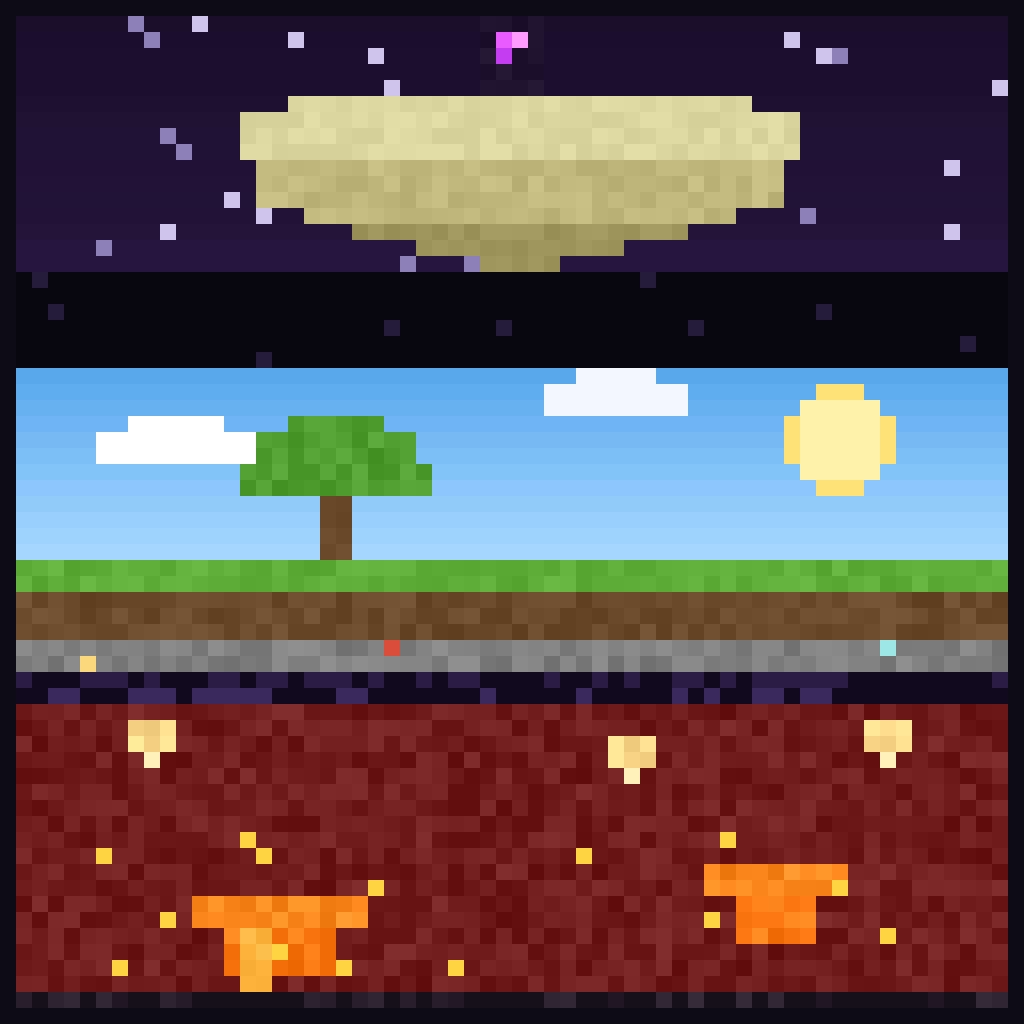
The first release of OneDimension — a world type that stacks the Nether, Overworld and End into a single dimension.
Added
- "One Dimension" world type. A new selectable world type that combines all three vanilla realms into one literal, height-stacked dimension (Nether below, Overworld at normal coordinates, the End near the world ceiling). The world contains only this single stacked dimension — there is no separate Nether or End.
- Stacked terrain generated by real vanilla worldgen for each band. The Overworld's bedrock floor becomes a mineable obsidian barrier, with the Nether ceiling sitting flush right beneath it — break through to descend into the Nether. A solid bedrock layer forms the world floor at the bottom of the Nether.
- Per-band biomes, mobs, features and structures — End cities and Nether fortresses
generate in their bands and are found by
/locate. - The full Ender Dragon fight — bedrock fountain and all ten spikes build in the End band; the dragon spawns, fights and dies normally, and the end credits roll when you step into the exit portal.
- In-dimension End and Nether portals that warp between bands instead of to separate dimensions.
- The Void Gate — an escalating-damage traversal band (with a hard death zone) between the surface and the End. It is permanently lifted once you defeat the dragon, so the End can then be reached on foot as a reward.
- Real Nether lava — lava in the Nether band flows fast and far like ultrawarm Nether lava, while Overworld lava behaves normally.
- Beds explode in the Nether and End bands, just like the real Nether/End; they still work for sleeping and setting spawn in the Overworld band.
- Day/night cycle and working clocks in the Overworld band.
- Per-band atmospherics — Overworld lighting/sky/fog/rain; the End has its proper dark End sky and fog with a full view distance, while the Void Gate in between is an ominous near-black fog. No clouds up top, and a brighter Nether.
- The dragon stays hidden unless you're up in the void zone or the End — no more spotting it floating over the Overworld.
Admin tools
/onedimension menu— an OP chest-menu panel (works on a vanilla client) to toggle the Void Gate hazards./onedimension voidgate damage|deathband <true|false>— toggle the escalating void damage and the instant-death band independently. Also editable in the config file.
Performance
- Outer-End generation is much faster: chunks that are pure End void now skip the End terrain pass entirely (large islands, the central island and the dragon arena are unaffected), and empty sections are skipped during band copying.
Known issues
- The dimension is tall, so it's heavier than a normal world — 4 GB+ of allocated RAM is recommended, especially at high render distances.