
Compatibility
Minecraft: Java Edition
Platforms


Tags
Creators
Details
Text Description
🌈 PrismaticAPI
The ultimate text-formatting engine for Bukkit/Paper plugins.
RGB colors · Gradients · Rainbows · MiniMessage · Interactive Messages




✨ What Is PrismaticAPI?
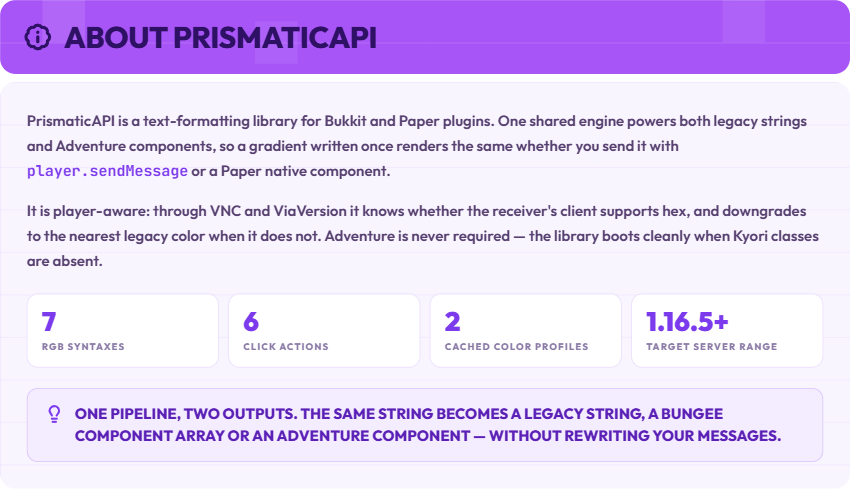
PrismaticAPI is a Bukkit/Paper text-formatting library that gives your plugin beautiful, modern text without the headache. One shared engine powers both legacy Bukkit strings and Adventure components — gradients, rainbows, per-player hex fallback, MiniMessage compatibility and interactive click/hover events all included.
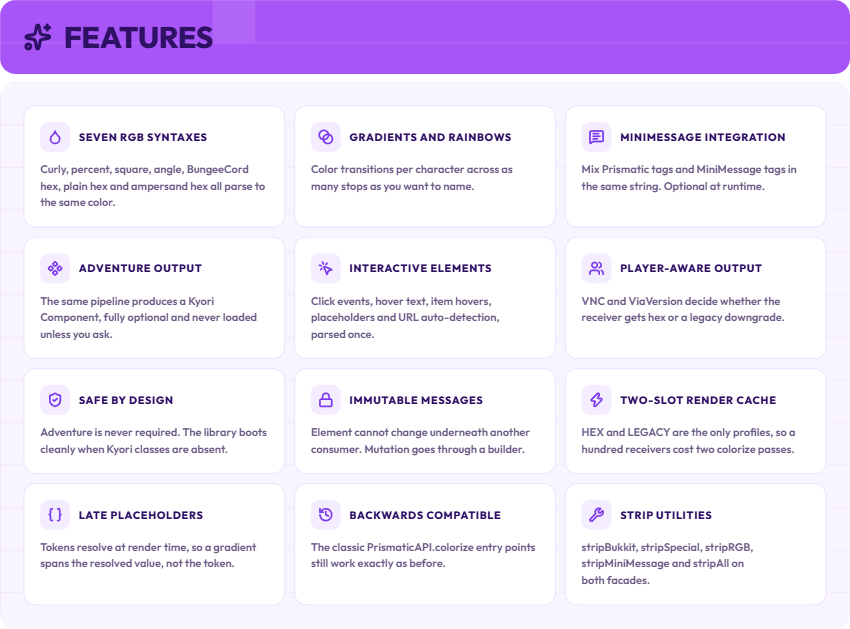
🚀 Features
- 🎨 Multiple RGB syntaxes —
{#ff8800},%#ff8800%,[#ff8800],<#ff8800>,&#ff8800,#ff8800,&xff8800 - 🌈 Gradient & Rainbow tags — color transitions per character, across as many color stops as you want
- 💬 MiniMessage integration — mix Prismatic tags and MiniMessage tags in the same string (optional at runtime)
- 🔮 Adventure support — produce
net.kyori.adventure.text.Componentoutput from the same pipeline, fully optional - 🕹️ Interactive messages —
Element: parsed once, click events, hover text, hover items, placeholders, URL auto-detection - 🧠 Player-aware formatting — VNC + ViaVersion integration to serve hex or legacy output depending on the player's Minecraft version
- 🛡️ Safe by design — Adventure is never required; the library boots cleanly even when it's absent
- ⚡ Backwards compatible — the classic
PrismaticAPI.colorize(...)methods still work unchanged
📦 How to Import
Gradle (Kotlin DSL)
repositories {
    maven("https://croabeast.github.io/repo/")
}

dependencies {
    implementation("me.croabeast:PrismaticAPI:1.5.0")
}
Gradle (Groovy DSL)
repositories {
    maven { url 'https://croabeast.github.io/repo/' }
}

dependencies {
    implementation 'me.croabeast:PrismaticAPI:1.5.0'
}
Maven
<repository>
    <id>croabeast-repo</id>
    <url>https://croabeast.github.io/repo/</url>
</repository>

<dependency>
    <groupId>me.croabeast</groupId>
    <artifactId>PrismaticAPI</artifactId>
    <version>1.5.0</version>
</dependency>
Tip: If your plugin uses
PrismaticAPI.adventure(), keep the Adventure API on your compile classpath and make sure the required Adventure runtime classes are present at startup.
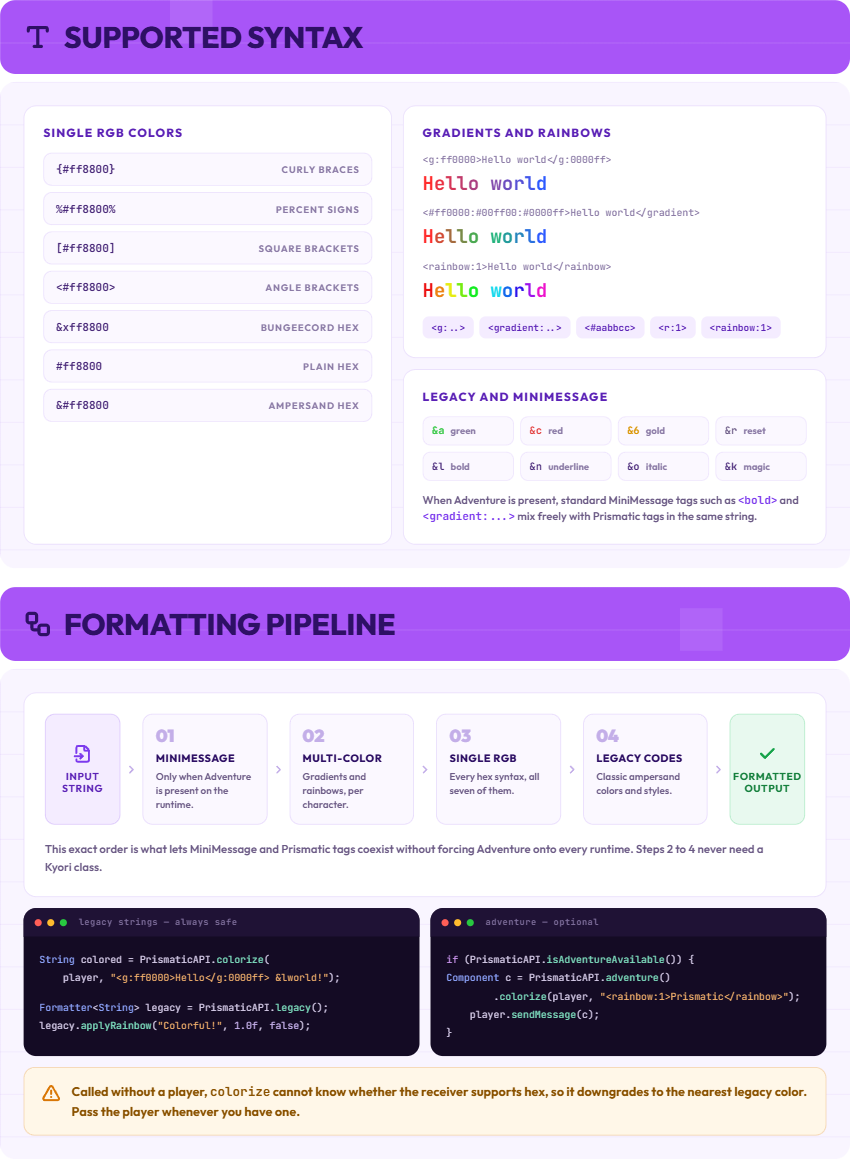
🧩 Supported Syntax
🎨 Single RGB Colors
| Syntax | Example |
|---|---|
| Curly braces | {#ff8800} |
| Percent signs | %#ff8800% |
| Square brackets | [#ff8800] |
| Angle brackets | <#ff8800> |
| BungeeCord hex | &xff8800 |
| Plain hex | #ff8800 |
| Ampersand hex | &#ff8800 |
🌈 Gradients
<g:ff0000>Hello world</g:0000ff>
<gradient:ff0000>Hello world</gradient:0000ff>
<#ff0000>Hello world</#0000ff>
<#ff0000:#00ff00:#0000ff>Hello world</gradient>   ← multi-stop!
🌀 Rainbows
<rainbow:1>Hello world</rainbow>
<r:1>Hello world</r>
📜 Legacy Formatting
&a  green        &l  bold
&c  red          &n  underline
&6  gold         &o  italic
&r  reset        &k  obfuscated
📝 MiniMessage (when Adventure is present)
Standard MiniMessage tags (<bold>, <red>, <gradient:...>, etc.) can be freely mixed with Prismatic tags in the same string.
📖 Quick Start
🟢 Legacy strings (always safe)
// Basic colorize
String colored = PrismaticAPI.colorize(player, "<g:ff0000>Hello</g:0000ff> &lworld!");
player.sendMessage(colored);

// Using the facade directly
Formatter<String> legacy = PrismaticAPI.legacy();

String gradient = legacy.applyGradient("Sunset",  new Color(255, 100, 0), new Color(255, 0, 100), false);
String rainbow  = legacy.applyRainbow("Colorful!", 1.0f, false);
String solid    = legacy.applyColor(new Color(0, 200, 255), "Aqua text", false);
🔵 Adventure components (optional)
if (PrismaticAPI.isAdventureAvailable()) {
    Formatter<Component> adv = PrismaticAPI.adventure();
    Component component = adv.colorize(player, "<rainbow:1>PrismaticAPI</rainbow>");
    player.sendMessage(component); // Paper native API
}
🖱️ Interactive messages
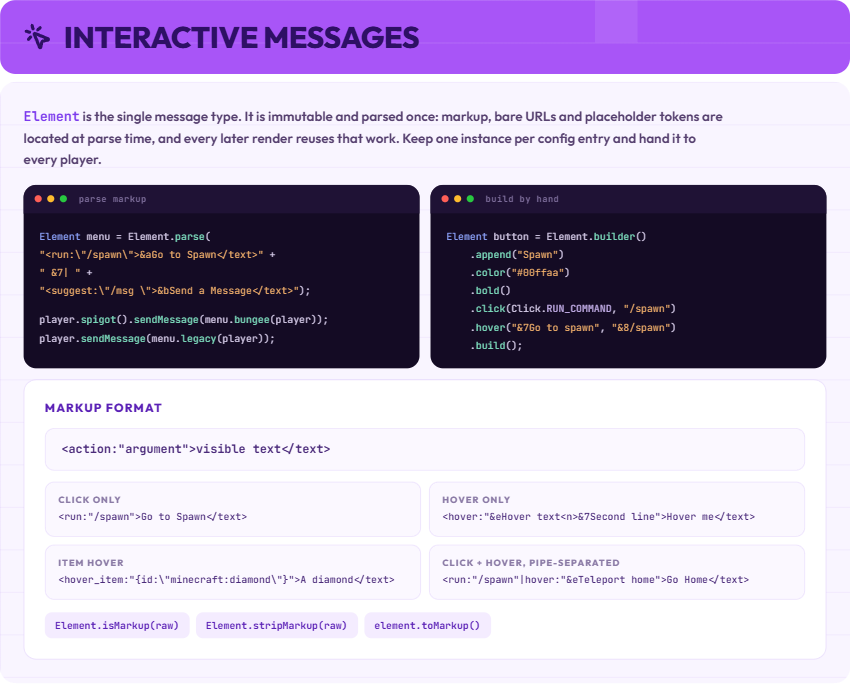
Element is the single message type. Parse once, render per player:
// Markup format: <action:"argument">text</text>
Element menu = Element.parse(
        "<run:\"/spawn\">&aGo to Spawn</text>" +
        " &7| " +
        "<suggest:\"/msg \">&bSend a Message</text>"
);

player.spigot().sendMessage(menu.bungee(player));
player.sendMessage(menu.legacy(player));
Build one by hand:
Element button = Element.text("Click me!")
        .toBuilder()
        .color("#ff8800")
        .click("run", "/help")
        .hover("&eOpen help menu", "&7Uses Prismatic colors")
        .build();

player.spigot().sendMessage(button.bungee(player));
Supported click actions in markup: execute / click / run / suggest / url / file / page / copy
🕹️ Element In Depth
Element is the single message type. It is immutable and parsed once: the interactive markup, the bare URLs and the placeholder tokens are located at parse time, and every later render reuses that work. Keep one instance per config entry and hand it to every player.
Element line = Element.parse("<g:ff8800>Welcome</g:00ffaa> &7{player}");

player.sendMessage(line.legacy(player));                 // legacy String
player.spigot().sendMessage(line.bungee(player));        // BaseComponent[]
Adventure output lives in a separate class on purpose, so a server without the Adventure runtime never loads a Kyori class by touching an element:
if (PrismaticAPI.isAdventureAvailable()) {
    Component c = AdventureElement.render(line, player);
}
🏗️ Building
Mutation goes through Element.Builder, so a shared instance can never change underneath another consumer. Style and event calls apply to the last appended segment.
Element button = Element.builder()
        .append("Spawn")
        .color("#00ffaa")
        .bold()
        .click(Click.RUN_COMMAND, "/spawn")
        .hover("&7Go to spawn", "&8/spawn")
        .build();

// derive from an existing element without touching it
Element louder = button.toBuilder().append(" &c!").build();
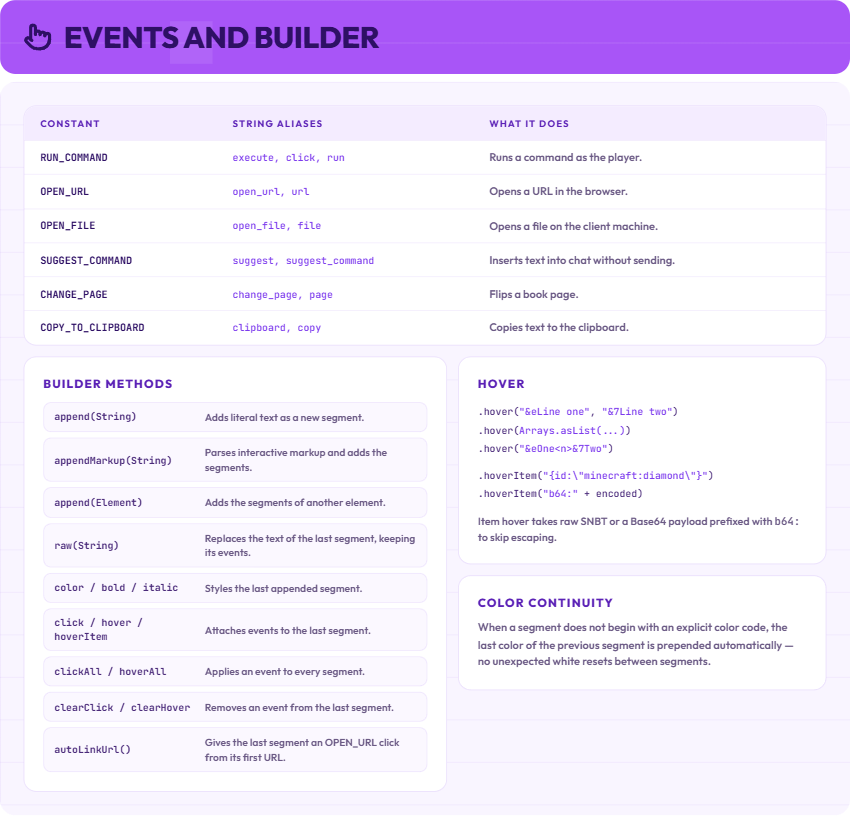
| Builder method | What it does |
|---|---|
append(String) |
Adds literal text as a new segment |
appendMarkup(String) |
Parses interactive markup and adds the segments |
append(Element) |
Adds the segments of another element |
raw(String) |
Replaces the text of the last segment, keeping its events |
color / bold / italic / underlined / strikethrough |
Styles the last segment |
click / hover / hoverItem |
Attaches events to the last segment |
clickAll / hoverAll |
Applies an event to every segment |
clearClick / clearHover |
Removes an event from the last segment |
autoLinkUrl() |
Gives the last segment an OPEN_URL click from the first URL in its text |
🖱️ Click events
The Click enum carries no platform type: the mapping to Bungee or Adventure happens inside the matching renderer.
| Constant | String aliases | What it does |
|---|---|---|
RUN_COMMAND |
execute, click, run, run_command |
Runs a command as the player |
OPEN_URL |
open_url, url |
Opens a URL in the browser |
OPEN_FILE |
open_file, file |
Opens a file on the client machine |
SUGGEST_COMMAND |
suggest, suggest_command |
Inserts text into chat without sending |
CHANGE_PAGE |
change_page, page |
Flips a book page |
COPY_TO_CLIPBOARD |
clipboard, copy, copy_to_clipboard |
Copies text to clipboard |
builder.click(Click.OPEN_URL, "https://example.com");  // enum constant
builder.click("url", "https://example.com");           // string alias
builder.click("run:/spawn");                           // compact "action:payload"
An unknown or blank alias resolves to SUGGEST_COMMAND.
💬 Hover
Text hover accepts varargs, a List<String>, or a single string using the <n> separator:
builder.hover("&eLine one", "&7Line two");
builder.hover(Arrays.asList("&eLine one", "&7Line two"));
builder.hover("&eLine one<n>&7Line two");
Item hover takes raw SNBT/NBT JSON, or a Base64 payload prefixed with b64: to avoid escaping issues:
builder.hoverItem("{id:\"minecraft:diamond_sword\",Count:1b}");
builder.hoverItem("b64:" + Base64.getUrlEncoder().withoutPadding().encodeToString(nbt.getBytes(UTF_8)));
🏷️ Markup format
<action:"argument">visible text</text>
<action:"arg1"|action2:"arg2">visible text</text>
- The opening tag holds one or two
action:"argument"pairs separated by|. - The closing tag is always
</text>. - Supported actions: every click alias from the table above, plus
hoverandhover_item.
<!-- click only -->
<run:"/spawn">Go to Spawn</text>

<!-- hover only -->
<hover:"&eThis is hover text<n>&7Second line">Hover over me</text>

<!-- item hover only -->
<hover_item:"{id:\"minecraft:diamond\",Count:1b}">A diamond</text>

<!-- click + hover (pipe-separated) -->
<run:"/spawn"|hover:"&eTeleport home">Go Home</text>
Utilities around the markup:
Element.isMarkup(raw);          // does the text contain interactive tags?
Element.stripMarkup(raw);       // drop the tags, keep the visible text
element.toMarkup();             // serialize back; re-parses to an equivalent element
Custom formats
MarkupFormat is the parsing strategy. Note that accept takes no player: parsing happens once and cannot depend on who receives the message.
Element parsed = Element.parse(raw, myFormat);
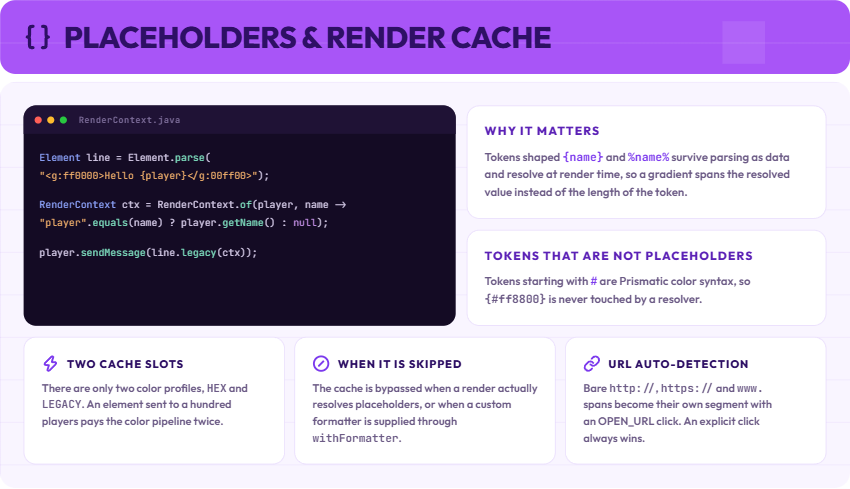
🧩 Placeholders
Tokens shaped {name} and %name% survive parsing as data and are resolved at render time. This is what lets a gradient span the resolved value instead of the length of the token:
Element line = Element.parse("<g:ff0000>Hello {player}</g:00ff00>");

RenderContext ctx = RenderContext.of(player, name ->
        "player".equals(name) ? player.getName() : null);

player.sendMessage(line.legacy(ctx));
A resolver returning null leaves the original token in place. Tokens starting with # are Prismatic color syntax, not placeholders, so {#ff8800} and %#ff8800% are never touched.
⚡ Render cache
There are only two color profiles, Target.HEX and Target.LEGACY, so each segment caches its colorized text in two slots. An element rendered to a hundred players pays the color pipeline twice.
The cache is skipped when a render actually resolves placeholders, or when a custom formatter is supplied via RenderContext.withFormatter(...).
toString() returns the raw text and never renders — it is called by string concatenation, logging and debuggers, none of which should trigger a render or need a player.
🔗 URL auto-detection
Element.parse turns any bare URL (http://, https:// or www.) in a non-markup span into its own segment with an OPEN_URL click. On a builder, call autoLinkUrl() explicitly. An explicit click always wins.
🎨 Color continuity
When a segment does not begin with an explicit color code, the last color of the previous segment is prepended automatically. This prevents unexpected white resets between segments:
"&aGreen text</text> and more text</text>"
                          ↑ automatically gets &a prepended
⚙️ Formatting Pipeline
PrismaticAPI processes text in this exact order:
Input string
    │
    ├─ 1. MiniMessage  ──────────── (only when Adventure is present)
    ├─ 2. Prismatic multi-color ─── gradients & rainbows
    ├─ 3. Single RGB codes ───────── {#ff8800}, <#ff8800>, &xff8800 …
    └─ 4. Legacy Bukkit codes ────── &a, &l, &r …
          │
          ▼
    Formatted output
This order lets MiniMessage and Prismatic tags coexist without requiring Adventure on every runtime.
🔧 Utility Methods
Both legacy() and adventure() facades expose the same helpers:
| Method | Description |
|---|---|
fromString(hex) |
Parse a color token or hex string into ChatColor |
stripBukkit(string) |
Remove &a, §a-style codes |
stripSpecial(string) |
Remove bold, italic, underline, etc. |
stripRGB(string) |
Remove gradient / rainbow / single-RGB syntax |
stripMiniMessage(string) |
Remove MiniMessage tags |
stripAll(string) |
Remove everything — returns plain text |
startsWithColor(string) |
true if the formatted string begins with a color code |
getStartColor(string) |
First color code in the formatted string |
getEndColor(string) |
Last color code in the formatted string |
⚠️ Important Behavior Notes
colorize(String) is conservative
When called without a Player, PrismaticAPI cannot detect whether the receiver supports hex, so it downgrades to the nearest legacy color. For player-aware output:
// ✅ player-aware: preserves RGB when the player's version supports it
String formatted = PrismaticAPI.legacy().colorize(player, raw);

// ⚠️ no player context: legacy fallback always
String formatted = PrismaticAPI.colorize(raw);
Adventure is always optional
PrismaticAPI runs perfectly without Adventure. Only PrismaticAPI.adventure() requires it. Guard the call:
if (PrismaticAPI.isAdventureAvailable()) {
    // safe to call PrismaticAPI.adventure()
}
Required Adventure classes at runtime:
net.kyori.adventure.text.Componentnet.kyori.adventure.text.minimessage.MiniMessagenet.kyori.adventure.text.minimessage.tag.resolver.TagResolvernet.kyori.adventure.text.serializer.legacy.LegacyComponentSerializer
🔄 Migration from 1.3.x
| Old API | New API |
|---|---|
PrismaticAPI.colorize(player, raw) |
Unchanged ✅ |
PrismaticAPI.applyGradient(...) |
Unchanged ✅ |
RichText text = PrismaticAPI.colorizeText(player, raw) |
PrismaticAPI.adventure().colorize(player, raw) |
text.component() |
Result of adventure().colorize(...) is already a Component |
applyColorText(...) |
PrismaticAPI.adventure().applyColor(...) |
applyGradientText(...) |
PrismaticAPI.adventure().applyGradient(...) |
applyRainbowText(...) |
PrismaticAPI.adventure().applyRainbow(...) |
🔄 Migration from 1.5.x
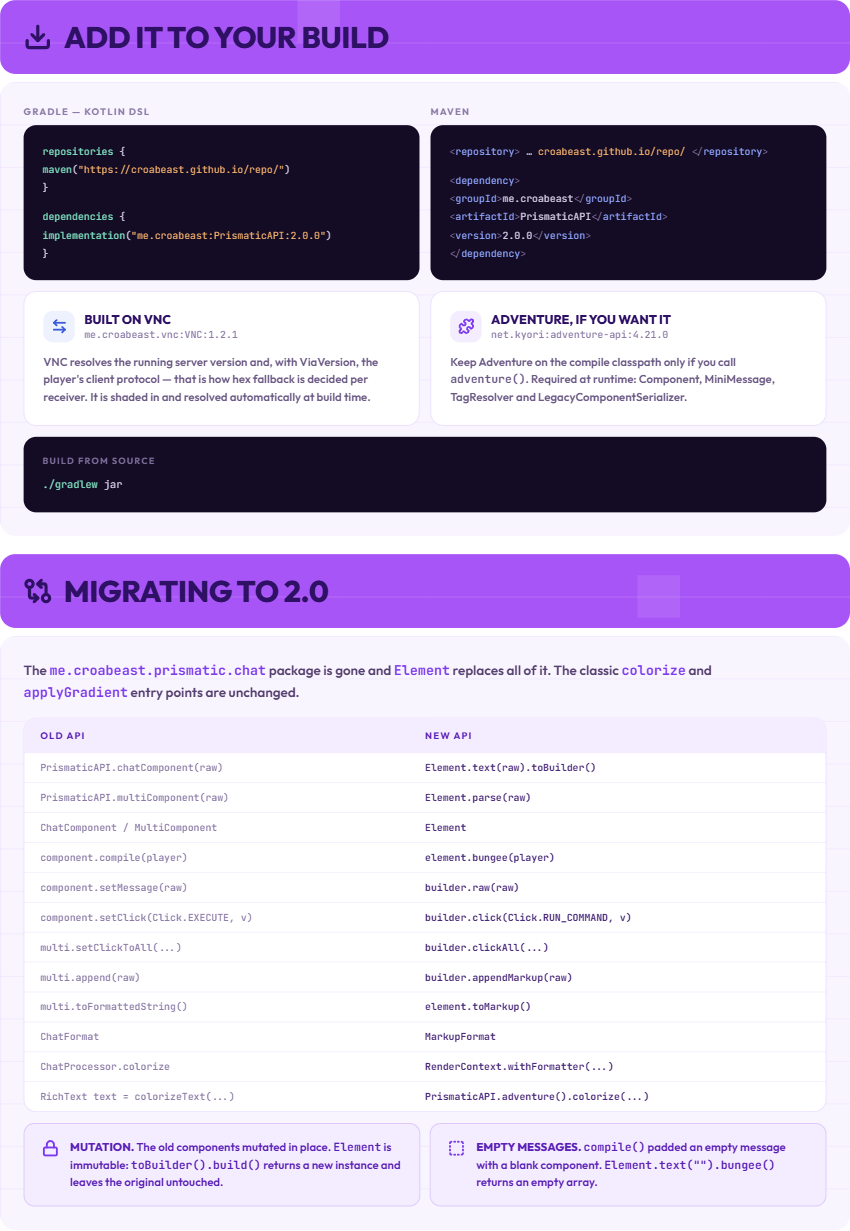
The me.croabeast.prismatic.chat package is gone. Element replaces all of it.
| Old API | New API |
|---|---|
PrismaticAPI.chatComponent(raw) |
Element.text(raw).toBuilder() |
PrismaticAPI.multiComponent(raw) |
Element.parse(raw) |
ChatComponent / MultiComponent |
Element (one type; a single segment is not a special case) |
component.compile(player) |
element.bungee(player) |
component.setMessage(raw) |
builder.raw(raw) |
component.setClick(Click.EXECUTE, v) |
builder.click(Click.RUN_COMMAND, v) |
component.setHover(...) |
builder.hover(...) |
component.setHoverItem(json) |
builder.hoverItem(json) |
multi.setClickToAll(...) |
builder.clickAll(...) |
multi.setHoverToAll(...) |
builder.hoverAll(...) |
multi.append(raw) |
builder.appendMarkup(raw) |
multi.copy() |
Not needed; Element is immutable |
multi.toFormattedString() |
element.toMarkup() |
ChatFormat |
MarkupFormat (no Player parameter) |
DEFAULT_FORMAT.removeFormat(raw) |
Element.stripMarkup(raw) |
DEFAULT_FORMAT.isFormatted(raw) |
Element.isMarkup(raw) |
ChatComponent.URL_PATTERN |
Element.URL_PATTERN |
ChatProcessor.colorize |
RenderContext.withFormatter(...) |
ChatProcessor.prepare |
MarkupFormat.prepare(...) |
ChatComponent.Click.EXECUTE |
Click.RUN_COMMAND (string aliases unchanged) |
ChatComponent.Click.SUGGEST |
Click.SUGGEST_COMMAND |
ChatComponent.Click.CLIPBOARD |
Click.COPY_TO_CLIPBOARD |
Two behaviour changes worth knowing:
- Mutation. The old components mutated in place;
Elementis immutable.element.toBuilder()...build()returns a new instance, and the original is untouched. - Empty messages.
compile()documented a non-empty array and padded an empty message with a blank component.Element.text("").bungee()returns an empty array.
🛠️ Building
./gradlew jar
This project depends on VNC (me.croabeast.vnc:VNC:1.2.1) from the CroaBeast Maven repository, which is automatically resolved during the build.
📄 License
See LICENSE for details.
Made with 💜 by CroaBeast